Showing posts with label books. Show all posts

Saturday, January 2, 2021

Our Family's Book Recommendations from 2020

Ryan recommends:

  • Misreading Scripture with Western Eyes by E. Randolph Richards and Brandon J. O'Brien

Marcelaine recommends:

  • The Hobbit and The Lord of the Rings trilogy by JRR Tolkien
  • The Harry Potter series by JK Rowling
  • The Bartimaeus Trilogy by Jonathan Stroud (the audiobooks are so fun)
  • The Chaos Queen series by Christopher Husberg
  • Greensleeves by Eloise Jarvis McGraw
  • Watership Down by Richard Adams
  • A Night Divided by Jennifer A. Nielsen
  • The Water Dancer by Tsa-Nehisi Coates
  • 1491 by Charles C. Mann (working on 1493 right now)
  • Where the Crawdads Sing by Delia Owens
  • Nausicaa of the Valley of the Wind, a graphic novel by Hiyao Miyazaki
  • The Ode Less Travelled by Stephen Fry
  • Jane Eyre by Charlotte Bronte
  • Mere Christianity by C.S. Lewis (I expected this to be dry and a little boring, but it's actually very engaging)
  • An Ember in the Ashes series by Sabaa Tahir
  • The Book Woman of Troublesome Creek by Kim Michele Richardson

  • Kevin recommends:
    • Heroes of Olympus and Trials of Apollo series by Rick Riordan
    Heidi recommends:
    • The False Prince series by Jennifer Nielsen
    Ann Marie recommends:
    • Swashby and the Sea by Beth Ferry
    • I Say Ooh You Say Aah by John Kane
    • La Princesa and the Pea by Susan Middleton Elya
    • Shelter by Celine Claire
    • Silent Night by Lara Hawthorne
    • Little Drummer Boy by Ezra Jack Ketas
    • Sulwe by Vashti Harrison
    • Belle, the Last Mule at Gee's Bend by Calvin Alexander Ramsey and Bettye Stroud
    • Monsters Love Underpants and Dinosaurs Love Underpants by Claire Freedman and Ben Cort
    • Octopants by Suzy Senior
    • Just Ask! by Sonia Sotomayor
    • Julia's House for Lost Creatures by Ben Hatke
    • Dragon's Extraordinary Egg by Debi Gliori 
    • Fear the Bunny by Richard T. Morris and Priscilla Burris
    • Not Quite Narwhal by Jessie Sima
    • Sweety by Andrea Zuill
    • The Forgetful Knight by Michelle Robinson and Fred Blunt
    • Too Many Carrots by Katy Hudson
    • Each Kindness by Jacqueline Woodson
    • The Unexpected Love Story of Alfred Fiddleduckling by Timothy Basil Ering
    • Dragon Was Terrible by Kelly DiPucchio
    • Hedgehugs by Steve Wilson and Lucy Tapper
    Ruby recommends:
    • Swashby and the Sea by Beth Ferry
    • Tuck Me In by Dean Hacohen and Sherry Scharschmidt
    • The Giant Jumperee by Julia Donaldson
    • There Is a Bird on Your Head by Mo Willems
    • Green Eggs and Ham by Dr. Seuss
    • Plus all the books Ann Marie recommended

    Wednesday, January 3, 2018

    Books that are Different But Interesting

    Some books are random or different enough that you have to be in the right mood to read them or else you'll hate them. But if you catch them at the right time when you're ready to read them with an open mind or just want something really different, they can be interesting. Here's a list of some books I've read that I think would fit in this category (with links to the titles on Good Reads):

    The Little Prince by Antoine de Saint-Exupéry

    Have Space Suit--Will Travel by Robert Heinlein

    Alan Mendelsohn, the Boy from Mars by Daniel Pinkwater (Also try Lizard Music.)

    Howl's Moving Castle series by Diana Wynne Jones

    Nausicaä of the Valley of the Wind by Hayao Miyazaki--a graphic novel that was the basis for the Studio Ghibli film produced by Miyazaki. Kevin has read this at least four times!

    Foundation by Isaac Asimov

    C.S. Lewis's Space Trilogy--Yes, C.S. Lewis wrote a space trilogy, and it's weird! Don't expect another Chronicles of Narnia. But it also explores some interesting subjects in theology and philosophy.

    Susan Cooper's The Dark Is Rising series

    The Giver series by Lois Lowry--The first book in the series, The Giver, is fairly well known and has a familiar style and plot, but I think many people haven't read the other three books in the series, which are a little strange but very riveting. In the fourth book you get to find out what happened to the mother of Gabe, the baby Jonas rescued in The Giver. Also try Gossamer by the same author.

    I also highly recommend Brandon Sanderson. His books are high fantasy and you will find them a little different, but the way he builds and explores worlds with new magic systems, religions, cultures, and politics is impressive. I would recommend starting with his Mistborn series.

    Wednesday, November 1, 2017

    12 Totally Readable Non-Fiction Books That Are Worth Reading

    One of my favorite General Ed classes in college was a history class called The World Since 1945. One of the reasons I loved it was that the professor had us read something like eight books about history and social issues throughout the semester, and in the labs we discussed the books. For me it was a turning point because I discovered that I can, in fact, read--and enjoy--non-fiction. Today I want to share with you a list of non-fiction books that are totally readable (non-fiction isn't always dry and boring). P.S. These aren't self-help books, either, because those aren't really my thing.

    I Am Malala: The Story of the Girl Who Stood Up for Education and Was Shot by the Taliban by Malala Yousafzai

    Who hasn't heard the story of Malala? When the Taliban took over the valley where Malala's family lived, she and her father continued to fight for girls' education, and eventually she was attacked and shot by the Taliban, and miraculously survived. Since then she has made her life's mission to fight for girls' right to education. In addition the book will give you a taste of Pakistani and Muslim culture. Personally I don't think the writing in this book was stellar, but the book is definitely worth reading.

    Thieves of State - Why Corruption Threatens Global Security by Sarah Chayes

    In this book, Chayes makes a compelling case that corruption is the cause (not a side result) of extremism and instability. She examines historical events as well as current instability in the Middle East and the role that corruption has played in these events. When governments are so corrupt that they are basically criminal gangs, the people get frustrated and tend to look to sources like religious extremism as the antidote to the problem, which results in groups like ISIS, the Taliban, and Boko Haram gaining power and inciting violence. And when world leaders trying to "help" these countries ignore the corruption, saying they'll deal with it once there's more stability, it makes them look complicit. This isn't just a third world problem, either--corruption is becoming more and more rampant in the US government, and ignoring it puts us at risk.

    The Dressmaker of Khair Khana: Five Sisters, One Remarkable Family, and the Woman Who Risked Everything to Keep Them Safe by Gayle Tzemach Lemmon

    This book will give you a sense of what it's like to live under a Taliban regime. It's the story of Kamila Sidiqi and her family and how they survived in Kabul when the Taliban seized control of the city. The women were forced to wear the burqa and remain completely covered (even their veils were more like tents with a slit of sheer fabric for them to see through) and never go in public without a male escort who was a family member--or risk getting beaten up by the Taliban. They were basically confined to their homes. Kamila's father and older brother had to leave the city, leaving the women and a younger brother to provide for themselves. Kamila started a sewing business in their home in order to support the family (she had to be escorted to the market by her little brother to buy supplies and do business transactions), and the business ended up growing enough to create work for many other women in the neighborhood.

    The Stone Manger--The Untold Story of the First Christmas by Jeffrey R. Chadwick

    This is the Nativity story as told by BYU professor of archaeology and religious studies Jeffrey R. Chadwick. Generally the story we tell about Christ's birth is that a Joseph and Mary were forced to make a last minute trip to Bethlehem to pay taxes, and while there Mary gave birth in a barn surrounded by cows and pigs and mounds of hay, then put the baby in a wooden manger filled with hay. The more probable story is rather different, and in many ways more inspiring and insightful. The book itself is very readable and only 133 pages.

    Disposable People: New Slavery in the Global Economy by Kevin Bales

    If you think slavery ended after the Civil War (I did, for a long time), you're wrong. Throughout the world, slavery and human trafficking are a widespread problem, but it looks different in the modern, global economy. (For more on this topic I highly recommended looking up Operation Underground Railroad and following their Facebook page.)

    Kon-Tiki: Across The Pacific In A Raft by Thor Heyerdahl

    This is the story of five men who challenged commonly accepted theories about the origins of the Polynesians by constructing a raft and sailing with five men from Peru to Polynesia, proving that the Polynesians' claims that they came from South America are plausible. This book was surprisingly riveting, not dry and boring at all.

    Half the Sky: Turning Oppression into Opportunity for Women Worldwide by Nicholas D. Kristof and Sheryl WuDunn

    This book makes a compelling case that the key to progress in developing countries is creating opportunity for women. They outline strategies that work (education in particular is super important) and share inspiring stories about many women who have risen out of horrible conditions to accomplish great things for their families and communities.

    Nothing to Envy: Ordinary Lives in North Korea by Barbara Demick

    If you've read 1984, imagine somebody reading that book and instead of being horrified, thinking, "Hmmm, that sounds like a great idea. I'm going to do that." That's North Korea. Demick interviewed six people who escaped from North Korea to South Korea and tells their stories in this book. North Korea has been fairly prevalent in the news of late, and I think a lot of people don't realize just how horrible conditions are for the majority of people there.

    Wild Swans: Three Daughters of China by Jung Chang

    This book tells the stories of Jung Chang and her mother and grandmother. The story begins with her grandmother's experiences as a warlord's concubine (complete with foot-binding), tells about her mother's experiences as part of the rising Communist party and how the family was impacted by the Cultural Revolution, and finishes with Jung Chang's experiences growing up in Communist China. It was pretty eye-opening to read this book and then look around at the Chinese grandmothers with the babies at the Baity Hill playground and realize they had lived through this.

    Iran Awakening: One Woman's Journey to Reclaim Her Life and Country by Shirin Ebadi and Azadeh Moaveni

    This is the story of Shirin Ebadi, who became the first female judge in Iran and was then demoted to a clerk after the Iran Revolution led by Ayatollah Khomeini led to Sharia Law being instituted in Iran. She became a human right's activist in Iran and as a lawyer represented many women and children who were not receiving justice, and for a time she was thrown in jail for her work. In 2003 she won the Nobel Prize. I appreciated that this book helped me understand the history of Iran, what life is like there, and why Iran hates the United States so much. FYI, the author doesn't really talk about the nuclear weapons program because that's not her purpose.

    Sisters in War: A Story of Love, Family, and Survival in the New Iraq by Christina Asquith

    This is the story of a family's experiences during the U.S. occupation in Iraq. The consequences for women after the invasion (especially with the rise of religious extremism) were something I hadn't known about before, so the book really opened my eyes. This book reads more like a novel than non-fiction.

    Hiroshima by John Hersey

    This book tells about the day the atom bomb was dropped on Hiroshima through the memories of survivors. Only 152 pages long.

    Friday, August 5, 2016

    Matched

    In May I was asked to host bookclub. We discussed the book Matched by Ally Condie. I had a stroke of genius and I came up with a few fun ideas. It was fun to get things ready. (I am not normally creative like this.) This will probaby make more sense if you've read the book.

    I sent the bookclub members the following email:

    Attention:
    You have been assigned to attend Book Club during your free rec hours this Thursday evening. Disregard any previous free rec assignments you may have received for this time. The Society has determined that this is the optimum free rec activity for you because (1) You are awesome, (2) Your data indicates that you have attended and enjoyed book club in the past, and (3) There will possibly be pie in honor of Citizen Samuel Reyes, recently deceased. 
    We remind you that missing your assigned free rec activity without a valid excuse may constitute an Infraction. 
    Your free rec activity will begin at 8:00 pm. Please take the air train to Citizen Tanner's apartment in Baity Borough or park your car in the S11 lot and walk up the stairs. Upon arrival please send Citizen Tanner a portal communication as only authorized persons are permitted to enter Baity Borough apartments. You may bring your official artifact. 
    Wishing you optimum results,
    Marcelaine Tanner
    I tried to match the language and tone of official messages in the book and throw in some references to things in the book.

    It was a crazy day, but I did manage to make pie by taking a shortcut and using refrigerated pie crusts. I have always made mine from scratch in the past except for buying a few graham cracker crusts, but I was pleasantly surprised by how well the refrigerated pie crusts turned out. It made things a lot simpler because all I had to do was lay the uncooked crusts into the pans and add filling. We had a razzle dazzle pie and a pumpkin pie and they were very yummy.

    I also put together some little bags with significant items from the book: a scrap of green fabric (Cassia was given a scrap from the green dress she wore at her match banquet), the poems Cassia's grandparents had hidden in her artifact (I ripped the edges down to size and crumpled the papers so they would look old), and three "pills" (skittles) like the ones all citizens in the Society are expected to keep with them at all times.


    We had an interesting discussion. I actually finished the rest of the series before our bookclub met, and to be honest I thought the other two books were just okay. In the second book all they did was walk around and be emotional and in the third book the plot was very interesting but the writing was way too flowery and poetic for my taste and I didn't think she tied the story together as completely as she could have. The characters were kind of flat, and when Cassia stuck sticks up her sleeves and pants and said it felt weird I had to throw the book down in disgust, because, duh, normal adults don't put sticks in their clothes, so of course it felt weird. But there were a lot of interesting things to discuss about the book and of course we also enjoyed chatting about other things.

    For some reason I rarely have friends over, so the idea that Mom was having a party was completely foreign to the kids. They kept asking questions trying to figure out what it meant that I had lots of friends coming over without their kids. When Ann Marie saw me setting the treats out on the table she excitedly went to get herself a plate and cried real tears when she had to go to bed without pie. (There were plenty of leftovers, so the kids got some the next day.)

    Wednesday, November 25, 2015

    Curious George

    I have a love/hate relationship with the Curious George books. The stories are kind of fun and my kids love them (we have a big book that has six of the books in it, and it's one of the most worn-out/well-loved books in our collection), but I get tired of them really fast and I'm completely exasperated by them sometimes, mostly because they're absurd (which is why kids love them so much) and so many people mooch off of George, especially the man in the yellow hat. I will show you what I mean by summarizing a few of the books and giving them more appropriate titles. (P.S. Don't take this post too seriously, please.)

    Curious George
    aka The Man in the Yellow Hat Kidnaps a Monkey

    In this book George is captured by the man in the yellow hat, who plans to sell him to the zoo. After they get on a boat, a very tearful George is allowed to freely roam the ship. (We won't go into how George's parents felt about their little monkey getting carried off since the book doesn't mention them.) He sees some gulls flying, and since he's apparently never seen birds before (despite having lived in a jungle his entire life) he thinks he can fly too, so he jumps off the ship and almost drowns. Fortunately, the sailors save him and he throws up four whole fish and about five gallons of water. At the man's house George smokes a pipe (!!!) and eats dinner, then goes to bed. The next day he plays with the phone and calls the fire department by dialing 123-4567. When the fire department discovers him, they put him in jail (which firemen are not legally allowed to do, not that anybody gets put in jail for making a prank call to the fire department, but you know . . .). George escapes through a window and then manages to get carried away by a large bunch of balloons, but when the wind dies down he begins to sink and unluckily gets recaptured by the man in the yellow hat, who is relieved that he can still get big bucks selling George to the zoo, but it's okay because a cage in a zoo is such a nice place for a monkey to live after he's spent his entire life in the jungle.

    Curious George Takes a Job
    aka George Escapes, but then a Lot of People Use him for Free Labor

    In this book George escapes from the zoo by stealing the zookeeper's keys and hiding with the elephants until the zookeepers are all gone. After exploring the city, he sneaks into a kitchen to steal some food. Unfortunately, he makes a big mess and gets caught. The cook makes him clean up the kitchen, and then, realizing that this is a very intelligent and efficient monkey, takes George to work for free washing windows with no safety equipment on the outside of a 14 (or more) story skyscraper. Out of the goodness of his heart, George paints a beautiful jungle mural in the nursery of a woman's apartment, and for this act of service he is chased out of the building by five people. To escape from them he jumps off the fire escape and breaks his leg.

    When the man in the yellow hat finds out what happened to George, he realizes he could make even more money off of George by making a movie about him, so he tells the hospital that he'll come pick George up after his leg has healed. (He doesn't mention any of this to the zoo, of course, since they would probably want their money back and he already spent it buying a new convertible and a helicopter [it's true--see Curious George Flies a Kite.)

    Finally, George's leg is better and the man comes to pick him up. He is almost killed when he smells an open bottle of Ether that the nurse had left on the floor in his room (!?!?!?!?!?!), but fortunately they are able to revive him with a cold shower, and the man hurriedly takes George to the movie studio where George signs a contract he can't read while the man and the studio director smoke cigars (!!!). He plays in the fake jungle at the movie studio all day while the man sits back smugly, looking forward to all the money he's going to get when the movie comes out.

    Curious George Rides a Bike
    aka More People Use George for Free Labor

    In this book George is given a new bike by the man in the yellow hat and then left at home by himself. The newsboy sees George playing with his new bike and convinces George to finish up his paper route so that he can go fishing with his friends at the nearby park (but still get paid for finishing his paper route, of course--it's not bad if George is having a good time, right?). George gets distracted and makes all of the newspapers into boats that float away down the stream (which is pretty incredible--I mean, have you ever tried to really float those things? They get soggy and sink in three seconds!) Then George starts riding his bike again, but unfortunately he hits a rock and the front wheel is ruined. That's okay, though, because George can ride on one wheel, so he heads home doing a wheelie. Then the owners of the animal show see him as they're riding down the street, and they decide to kidnap him and put him in their act (free labor, you know). They fix his bike, dress him up, and give him a trumpet. George almost kills the ostrich trying to feed it his trumpet, but it turns out okay because then he saves the baby bear. The man in the yellow hat shows up to the animal show and is thrilled to find his monkey because he had been worried sick at the thought that someone else was making money off of George instead of him.

    Curious George gets a Medal
    aka George Floods the Man's House and the Man in the Yellow Hat Thinks of Another Way to Make Money off of George

    In this book George spills ink all over the carpet and tries to clean it up with soap and water, but he gets a little carried away and floods the house. He steals a cow and a water pump from a nearby farmer, but the farmer chases him and he has to make a getaway on a museum truck. George explores the museum and ruins a dinosaur exhibit, but it all works out okay because the museum director wants to do an experiment on him and the man in the yellow hat has agreed because the museum director will pay him big bucks for the use of his monkey. George is launched into space and then bails out of the space ship using a parachute. George gets a medal and the man in the yellow hat gets lots of money.

    Curious George Goes to the Hospital

    I don't really have any objections to this book, but I'm seriously grossed out by the fact that the doctor saved the puzzle piece George had swallowed, and that George and the man in the yellow hat went home and happily put it into the puzzle as if it was no big deal that it had been inside a monkey's BODY for three days. Oh, and everything my kids know about hospitals they learned from this book (and their minor surgeries), and they love to reenact scenes from the book using Ann Marie as their patient.

    Friday, January 3, 2014

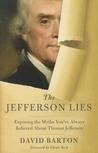
    Goodreads Review: The Jefferson Lies

    The Jefferson Lies: Exposing the Myths You've Always Believed about Thomas JeffersonThe Jefferson Lies: Exposing the Myths You've Always Believed about Thomas Jefferson by David Barton
    My rating: 4 of 5 stars

    I think this book was worth the read and I highly recommend it. Aside from all of the things I learned about Thomas Jefferson, I gained a lot of important insights into the way our society currently views history, people, politics, religion, civil rights, and so on. It has given me some useful tools for recognizing truth and lies when I see things on the internet.

    Many of the myths that are addressed by Barton originated with people of Jefferson's time who were trying to ruin him politically. The rumor that he fathered at least one of the children of one of his slaves probably originated with a person who got mad at Jefferson and spent the rest of his life running a smear campaign against him (Jefferson actually wanted to free his slaves but was prevented by Virginia laws). Many of the myths about his religious beliefs were originated by clergymen and/or politicians who were Federalists and told outright lies about Jefferson in order to dissuade people from voting for him. It's kind of like what would happen if someone 80 years from now used nothing but Fox News to write a biography of Barack Obama. Probably the biography would be biased and not very accurate. Barton has done a great job looking at the original sources, especially Jefferson's own writings, and trying to understand the historical context so he could paint a more accurate picture of what really happened.

    I do think that it might have been better to organize the book a little differently. Most of the chapters were about Jefferson's religious beliefs, and by the end I felt like it was becoming a little overkill because the myths were already obviously false based on previous chapters. That's not to say that he shouldn't have included some of the content, but I think it should have been organized a little better so that it didn't feel like I was reading the same chapter over and over again.

    The last chapter is really interesting, and not just because of the content, but also because Barton's point of view about Christianity is very obvious. In the last chapter he is addressing whether Jefferson was an atheist and whether he was a Christian. After addressing whether he was an atheist (definitely not), he moves on to discuss why he believes Thomas Jefferson probably was not a Christian when he died. In his later years, Jefferson was very interested in the Restorationist movement that aimed to become more like the church Christ organized on the earth. The leaders of this movement generally rejected the creeds and the doctrine of the Trinity because these were not in the Bible. Jefferson seemed to agree with them and wrote that he believed that the focus should be mostly on the gospels and not on the epistles. That is why Barton argues that Jefferson was not a Christian. (LDS friends, keep in mind that most Christians' definition of being a Christian is not simply believing in Christ, but also has a great deal to do with whether a person believes in the creeds and the Trinity.) Interestingly, Sidney Rigdon was a follower of Alexander Campbell, one of the leading ministers in the Restorationist movement. A lot of the principles supported by the Restorationists were also important in the organization of the LDS church, which is interesting since Thomas Jefferson was one of the Eminent Men whose temple work was done by proxy by Wilford Woodruff.

    View all my reviews

    Saturday, September 21, 2013

    Goodreads Review: The Little Fire Engine by Lois Lenski

    The Little Fire EngineThe Little Fire Engine by Lois Lenski
    My rating: 1 of 5 stars

    I hated this book so much I had to write a review about it.

    Fireman Small and the other firefighters are called to save a burning house. They go there in a fire truck that says the same thing as the Winkies in the Wizard of Oz (ooo-weee-oooo). I could not figure out how to make that sound like a siren.

    They get to the house and it is obviously a serious situation because smoke is coming out of the windows and doors. So Fireman Small sends his firefighters straight in with nothing but various sharp blades to find the fire.

    Meanwhile, Fireman Small and another firefighter are preparing the pump and hose. The family is removing furniture from their house that has copious amounts of smoke coming out of it.

    Then the plot thickens. One of the daughters is trapped on the second floor with her kitty and there are flames behind her. Apparently the family was so busy saving their furniture that they didn't bother to make sure the kids were all safely out of the house. But it's okay, because Fireman Small saves the girl and the kitty using the ladder.

    By this point the fire has reached the attic, according to the report of the firefighters who went inside the house to explore, so Fireman Small climbs the ladder to the roof, chops a hole in it, and sprays water through the hole, extinguishing the fire. (This is not why firemen chop holes in roofs, by the way.)

    Amazingly, although the house was up in flames, it was saved by Fireman Small's heroic efforts. He tells the family that their house is saved and they can go ahead and move all of their furniture back into their soggy, smoke-damaged home that has a hole in the roof, and the firemen drive back to the firehouse. What a happy ending.

    You may have guessed that this is probably not a great book to use if you want to teach fire safety.

    View all my reviews

    Saturday, August 17, 2013

    Deconstructionism

    "In short, Deconstructionism is a steady flow of belittling and negative portrayals of Western heroes, beliefs, values, and institutions. Deconstructionists make their living by telling only part of the story and spinning it negatively, manipulating others into supporting their views and objectives.

    "Deconstruction of American heroes, values, and institutions--which especially occurs in today's classrooms--is the reason most Americans can recite more of what's wrong with our nation than what's right . . .

    "Under Deconstructionism students are similarly taught about the 'intolerant' Christian Puritans who conducted the infamous witch trials. And while twenty-seven individuals died in the Massachusetts witch trials, almost universally ignored is the fact that witch trials were occuring across the world at that time; in Europe, 500,000 were put to death, including 30,000 in England, 75,000 in France, and 100,000 in Germany. Additionally, the American witch trials lasted eighteen months, but the European trials lasted years . . . Twenty-seven deaths in America but 500,000 in Europe? Why emphasize the twenty-seven but ignore the 500,000? The answer is "Deconstructionism"--presenting a negative portrayal of American faith and values . . .

    "In short, Deconstructionists happily point out everything that can possibly be portrayed as a flaw--even if they have to distort information to do so--but they remain conspicuously silent about the multitude of reasons to be proud of America and its many successes and heroes . . .

    "American Exceptionalism is no longer recognized, understood, or venerated. To the contrary, many American political officials now feel compelled to apologize to the world for America; they are conscious of our flaws but seem ignorantly oblivious to our matchless benefits and opportunities."

    --The Jefferson Lies, David Barton

    These were some phrases that stood out to me in the introduction of the book. I am seeing this point of view a lot these days, and I find it very troubling. They portray America as one of the most sexist, racist, ignorant nations in the world and don't acknowledge its many accomplishments and blessings. I find it a little frustrating that we feel the need to apologize to the world for our existence and yet we're almost always expected to be there to help (and take the blame) when other countries are in trouble.

    I was actually surprised that only twenty-seven people died in the Salem witch trials. The way they talk about it in school, you would think that hundreds of people were killed.

    Wednesday, July 24, 2013

    Goodreads Review: Ethnic America by Thomas Sowell

    Ethnic America: A HistoryEthnic America: A History by Thomas Sowell
    My rating: 4 of 5 stars

    It always seems like an accomplishment when I finish a non-fiction book, but this one was well worth the seven weeks it took to read it. Ethnic America has some very interesting insights. Sowell analyzes several ethnic groups (Chinese, Japanese, Irish, Italian, African, Mexican, Puerto Rican, German, Jews--each group gets its own chapter) that have immigrated to the United States at various times. He discusses their background in their homeland and reasons for emigrating, how they fared and what their occupations were once they came here, and how their children, and then grandchildren, fared. If you want to understand issues like immigration, discrimination, and affirmative action better, this is a good read. It was written in the 1980s, so it is a little out of date, but I was still able to learn a lot from it.

    Here are some of the things that stuck out to me as I was reading:

    (I think this was meant to be Sowell's thesis, although he didn't do a great job of making it clear.) When we see inequality of income when comparing different ethnic groups, our society tends to immediately point to racism and discrimination as the cause. But often the differences have more to do with factors like the region the ethnic group tends to live in, cultural differences, or average age of the ethnic group--and people who point this out are discounted and called racists! For example, if you look at national averages, African Americans have lower incomes than the national average. But if you compare incomes in specific regions, African American incomes are similar to those of others in the same region. Sowell says that African American incomes are lower than the national average because they are concentrated in the South, where income is lower for most people than the national average. So they have lower incomes because they live in a poorer region, and not necessarily because of discrimination. It's rather unfortunate that the default is to point to racism because it can prevent the real problem from being addressed, and it creates contention unnecessarily.

    Most of the immigrant groups had a difficult time at first. The incomes of the first generation tended to be low, and often they had bad living conditions. The second generation tended to do a little better, and by the third or fourth generation most groups seem to have reached the national average for income. When children were allowed and encouraged to attend public school, it was beneficial for the immigrants because the children learned English and American customs and policies there, and were therefore able to help their parents to become more acculturated as well. The Chinese had a very difficult time because there were so many single men or men who had left their families behind in China, and then immigration policies prevented more Chinese from coming to the United States, which meant that for a long time there was no second generation to help the first generation immigrants adjust to American culture.

    It seems to me that it is worth it to invest in helping immigrants become acculturated, especially to help them learn English and teach their children. In the past, policies that have discriminated against immigrant groups (for example, the Chinese) prevented them from adjusting and thriving in the United States, which led to disease and violence. In the long run, helping them adjust is less costly because they can then contribute to our society.

    I think it is important for the United States to enable people to immigrate here legally. Right now the process for doing so is very difficult, and nearly impossible for people who are poor and barely literate (Ryan's advisor from Germany said it was easier to apply to graduate school than it was to apply for a green card--and if that's what a professor thinks, how easy do you think it is for someone with very little education?). Yes, initially it can be a little costly because of ESL programs and such, but in general the ethnic groups that Sowell talked about adjusted to American life with in a couple of generations, and mainly this was accomplished through their own hard work and the things their children learned in public school. We also benefit from the influence of other cultures. For example, one of the most important contributions that the Germans made was to show other [very Puritanical] Americans that there is no harm in good, clean fun. They came with a love of sports, music, dancing, and other entertainment and helped other Americans to enjoy that too. I think we would be a very different place without that influence.

    Conditions in the immigrants' country of origin played a huge role in how they lived after coming to the United States. The Irish had been suppressed by England for so long that they learned how to develop their own groups to support different causes, which is why they were so good at building up the political machines in the United States. The Italians were suppressed too, but it was different because they lived in small villages that were basically run by one rich person who could do whatever he wanted to the poor villagers, so the Italians learned to be most loyal to their family and close friends, which meant that in the United States they weren't as inclined to start larger groups for Italians in general as the Irish had been. Both the Irish and Italians lacked a desire to "go the extra mile" because in their country of origin it could actually do more harm than good to work harder than you had to, which in some ways inhibited their ability in the United States to move upward. Cultural characteristics like these could persist for several generations.


    View all my reviews

    Thursday, April 18, 2013

    The Poky Little Puppy--What Really Happened

    Five little puppies dug a hole under the fence and went for a walk in the wide, wide world. They wandered far away from home and climbed up a hill. When they got to the top of the hill, they counted themselves: One, two, three, four. One little puppy wasn't there. They looked all around the sides of the hill and couldn't see him, although they saw all sorts of other things like lizards and caterpillars. But when they looked down at the bottom of the hill they saw him running around and around. So they ran down the hill, tumble bumble, and asked him what in the world he was doing. "I smell something," he said. Then they all realized they could smell rice pudding cooking. So they all ran home.

    As they approached the fence, the first four little puppies slipped under the fence as fast as they could because they were so excited about rice pudding. The poky little puppy was more cautious, and he noticed that he could see their mother's fur through the fence, so he held back so that he wouldn't get in trouble for digging the hole. He stopped and chatted with the neighbor dog for a while.

    "So you're the little puppies who dig holes under fences!" their mother said. "No rice pudding for you! Go straight to bed!" So the four little puppies went to bed hungry.

    The poky little puppy finally came home and slipped under the fence. He didn't know that the other puppies had been denied their rice pudding, but he did notice that there was plenty left, and he was very hungry, so he licked the bowl clean and went to bed, happy as a lark.

    The next day the hole in the fence had been filled in, and there was a sign that said, "Don't ever dig holes under this fence!" But the five little puppies dug a hole under the fence just the same and went for a walk in the wide, wide world. They decided to go back to the hill since they hadn't spent much time there the day before.

    When they got to the top of the hill they counted themselves: One, two, three, four. One little puppy wasn't there. "Now where in the world is that poky little puppy?" they wondered. They looked all over the hill and saw some interesting things like spiders and grasshoppers, but they didn't see the poky little puppy. Then they saw him at the bottom of the hill, with one ear cocked up. So they ran down the hill, tumble bumble, and asked what he was doing. "I hear something," he said. "Chocolate custard!" they all cried. "Someone is spooning it into our bowls!" So they went running home, and apparently they hadn't learned their lesson, because the four little puppies dove through the hole in the fence without looking where they were going,, and there was their mother again. "So you're the little puppies who dig holes under fences!" she said. "No chocolate custard tonight! Go straight to bed!" So the four little puppies had to go to bed hungry, and they were very sad.

    The poky little puppy figured their mother might be waiting again, so he held back and approached the fence with caution. He had to wait a while because she was standing at the kitchen window washing dishes and would see him slip under the fence, but when he had a chance he snuck into the yard and came inside. He saw the big bowl of chocolate custard and just couldn't help himself--he ate it all up, and went to bed, happy as a lark.

    The next morning there was a sign by the fence that said, "Don't ever, ever dig holes under this fence!" But the five little puppies dug a hole under the fence just the same and went for a walk in the wide, wide world. Once again, they ran to explore the hill. When they got to the top, they counted themselves: One, two, three, four. One little puppy wasn't there. "Now where in the world is that poky little puppy?" they wondered. For he certainly wasn't on top of the hill. They looked around on the sides of the hill and saw some other stuff, but no poky little puppy. But then they saw him at the bottom of the hill with his nose to the ground, and they ran down the hill, tumble bumble, to see what he was doing. "I see something," said the poky little puppy. Then they realized he was looking at a wild strawberry, and that reminded them that their mother was making them strawberry shortcake, so they ran home as fast as they could.

    When the four little puppies slipped under the fence, their mother was there waiting again, and she said, "So you're the little puppies who dig holes under fences! No strawberry shortcake tonight! Go straight to bed!"

    The four little puppies were getting desperate because they hadn't eaten anything for three days, so they snuck outside while they thought their mother wasn't looking and filled up the hole in the fence. They turned around and found their mother standing there, watching them proudly. "What good little puppies!" she said. "Come have some strawberry shortcake."

    As usual, the poky little puppy took his time. He got pretty nervous when he realized his brothers and sisters were filling in the hole. He had to squeeze under a gap in the fence to get back home. He arrived home just in time to find his siblings licking up the last of the strawberry shortcake.

    "Oh, dear! What a pity you're so poky!" their mother said. So the poky little puppy went to bed with no strawberry shortcake, feeling very sorry for himself and rather hurt that nobody thought to save any dessert for him. (Years later when he had puppies of his own he realized that his mother probably knew all along that he had secretly eaten the entire pan of rice pudding and the entire bowl of chocolate custard and therefore didn't need or deserve any strawberry shortcake.)

    The next day there was a sign that said, "No desserts ever unless puppies never dig holes under this fence again!"

    And the moral of the story is:

    • Avoid doing sneaky things with siblings who aren't old enough to be sneaky without getting caught. If you do decide to do it, know how to bail out before it's too late.
    • If you have a chance to eat dessert, do it, because they might decide to eat it while you are gone and forget to save some for you.
    • Sometimes it's advantageous to be sneaky by yourself because then you don't have to share.
    • In most cases Mom really does know you did it, even if she didn't actually catch you in the act.
    Right?

    (P.S. I still love the book, especially because of my childhood memories of reading it with my parents.)
    (P.P.S. I was the poky little puppy.)

    Sunday, May 13, 2012

    Finals were over last week. This semester I didn't end up feeling burned out a month before it was over. Maybe that's because I wasn't taking physics, chemistry, or calculus, and I wasn't eight months pregnant. It might also help that the two classes I took this semester were very good.

    But it's still nice to be done for a while. We've had a fun week. I've gotten Kevin outside for a walk or to play most days this week, which has made him a lot more pleasant to be around.

     On Friday we went to a new park with some friends. This area has a lot of parks, which is good, because the variety makes Kevin much less inclined to run away. He stayed at the playground the whole time and I never had to chase him down.

    Yesterday we finally got around to picking strawberries. I didn't want to go alone, so I asked Ryan to come with me and we brought the kids. I really should have gone alone. Heidi wasn't happy to be on my back in the Ergo. She wanted to eat strawberries. Kevin was a lot better than last year. He helped Ryan. Ryan told him to only pick the red ones, and he understood that, but he also picked a lot of mushy ones that I ended up having to throw away. So I'm going to have to go again to get more, and this time I'm going alone. I've learned my lesson. All my friends blog about taking their kids to pick strawberries and how much fun they have, but that's just not my family. And I'm pretty hardcore about my strawberry picking because I'm trying to replenish our freezer jam supply here, not just make a couple of smoothies, so I probably can't expect to get as many good berries as I want if I take the kids. Oh well.

    I'm working my way through Undaunted by Gerald N. Lund. I'm not a huge fan of his writing style, but he does tell pretty good stories. Things have picked up in the book now, and for the most part I'm really enjoying it. It's about the pioneers who went to the Hole in the Rock and the hardships they faced. I appreciate what Lund is trying to accomplish by writing this book. A lot of people say that the expedition was a mistake, but he's trying to show that just like with the Willie and Martin handcart companies, it wasn't a mistake. The people that went built up strong testimonies, and they went because they needed to build up peaceful relations with the Native Americans in order to protect the Latter-Day Saints in Southern Utah. I'm enjoying learning about it. It's a part of church history that we don't talk about very much. We tend to talk about the pioneers reaching Salt Lake and then stop there, but a lot happened after that. I'm going to have to look up some of these books that Lund used as resources so that I can learn more about it.

    Friday, March 23, 2012

    China Road: A Journey into the Future of a Rising PowerChina Road: A Journey into the Future of a Rising Power by Rob Gifford

    My rating: 5 of 5 stars


    This was a really interesting and enjoyable read. Gifford traveled all the way along China's Route 312 and tells about the people he meets all along the way, from Shanghai in the east to the border of Kazakhstan in the west. I enjoyed his style, and I think Gifford was overall pretty complimentary of China while still explaining the problems it faces.

    One of the things I realized was that the authoritarian approach in China is pretty effective. I tend to think that authoritarian equals bad and democracy equals good, but while I don't necessarily think it's fair to the people that the government still has so much control over the people's lives, I can acknowledge that the government seems to know what they're doing and is effective at facilitating high economic growth and keeping the country together. It's investing everywhere in buildings and roads so that people can start up businesses and transport goods effectively, and that's important. In India the economy's growth is really limited by the bad roads. In India Express I read that 40% of produce spoils before it gets to market because the roads are bumpy and trucks are frequently stalled for days. China recognizes that a lot of people are not content with the government, especially the people in the west, like in Tibet, who feel that they should be independent from China, and so the government is doing things like putting money into the economies in those areas, and also indoctrinating children in the schools, in order to make China more unified. I wouldn't say I like that, but I'm impressed that the government can be organized and plan ahead enough to carry it out. I do think that at some point China will have to become more democratic, though--more and more Chinese people want democracy, and if it becomes a big enough movement it could lead to a revolution. Last time that happened, Mao Zedong came into power and the next several decades were insane. It would be nice if somehow Chinese people could get their voice without chaos ensuing. At this point, most aspects of people's lives are not controlled by the government, but political dissent is still not tolerated.


    View all my reviews
    India Express: The Future of the New SuperpowerIndia Express: The Future of the New Superpower by Daniel Lak

    My rating: 2 of 5 stars


    This was an okay book. It took me a while to get into it. I don't think Lak is making a convincing enough argument that India will be the next superpower. He spends the entire book outlining all sorts of significant problems that India has (sanitation, poverty, illiteracy rates, ineffective and corrupt leaders, bad roads, pollution) but still declares that in a few decades India will not only overcome those problems, but get better than the rest of the world. I don't disagree that India has the potential to become a superpower, but I don't think those problems should be brushed aside in the way he does. I think he should have taken a softer, less biased approach instead of saying India absolutely will be the next superpower. The index at the back of the book was also poorly written, by the way. Pakistan doesn't even show up in the index.


    But, I did find many of the stories interesting. He talked about a man who started breeding farms for worms in order to make good soil without copious amounts of chemicals. The problems with disposal of human waste are heart-wrenching. Much of India just doesn't get the concept of sewage systems, and they're still using a system of sweepers--people who make a living collecting and disposing of the waste. It's a horrible job and those people have no hope of rising out of poverty because they are so susceptible to disease and nobody wants to come anywhere near them. I also didn't realize how bad the pollution is. Indians are going to have to develop an understanding of how their actions affect their environment--i.e. they can't just throw whatever they want to into the river, they can't use prolific amounts of chemicals to fertilize the soil, and they can't just "do their business" in a field somewhere.


    View all my reviews

    Sunday, September 18, 2011

    how to feel two opposite emotions at once

    I am learning that it is possible to feel both ends of a spectrum of emotions at the same time . . . like one time this week when Kevin was being wild and I had a test to study for and I felt about as stressed as it gets, but at the same time I was feeding Heidi and I felt so peaceful and calm. It was kind of strange.

    I have been wanting to read the book Making the "Terrible" Twos Terrific for quite a while, but the library didn't have it. I don't like to buy books unless they're ones I've read and I reread them often, but one day I had an impression that I should buy this book, and I had some Amazon gift card money, so I ordered it, although I wasn't sure when I would find time to read it. After my test on Thursday I decided to give myself a treat and I read a couple of chapters that afternoon. I am so glad I bought it! It has already changed my perspective on what is happening with my two-year-old's mind (and I think the twos started when he was about 12 months old). I think the most helpful thing that the author has pointed out is that you can't really expect to correct a two-year-old's behavior, so you have to do your best to contain it. Of course, it's kind of discouraging to read that because that means that Kevin is going to keep throwing food and climbing out of his crib and hitting his sister and my attempts at correcting those behaviors won't seem very effective for quite a while. But it's also a relief because it means that I don't have to feel bad that nothing seems to work to get him to behave better--i.e. not being able to get him to behave well is not my fault and it's not due to a deficiency in my parenting. Maybe that sounds obvious to some people, and I knew it deep down, but I've also felt a lot of pressure from some sources, even a couple of talks at church, to think that I need to be able to just give my kids The Look to keep them in line, and it was making me kind of depressed. I'll try to post some notes later on when I get some time to read more, but I am so grateful that I took a little time to read the book and get a better perspective. Here are a couple of things that have stuck out to me so far: One of the things he talks about is getting toys that have a lot of play value and foster creativity, and it gave me the idea to give Kevin some of the pots and pans and spoons that I never use so he can play kitchen. I think he'll enjoy that. I also really appreciate that the author states over and over that the most important thing in the family is the marriage, not the children. I know that sounds kind of mean at first, but if you think about it, it makes a lot of sense. If you want a stable family, that will come from the example of the mother and father's stable and loving relationship. Also, self-esteem is earned, not bestowed. Children will have good self-esteem if they learn how to try hard and do their best, because then they will be confident that they can accomplish things through their own effort.

    I try to be honest but still positive in my blog posts, which is partly why I share a lot of these inner struggles that I have with mothering. I really don't want to be the mom that has the perfect blog about her perfect life.

    I'm figuring out ways to get more homework done. I try to get a little done in the morning before I go to class, and I also try to use naptime wisely. I still don't feel like I am getting as much homework done as I'm supposed to, but I'm sure working hard. Unfortunately, the housework is suffering . . . but Ryan is doing a lot. And he made some heavenly cinnamon rolls with cream cheese frosting this evening. Physics is starting to get better. I am understanding better how to approach the problems. It's still challenging and I get really frustrated, but it also feels good to realize that I'm starting to figure it out. It's interesting to tell Ryan about things I'm learning in Chemistry, like the ideal gas law, and have him respond with, "Yeah, I have that programmed into the code that I'm writing."

    I've also figured out how to cook large portions of meat and then use it in my meals throughout the week. I buy the bags of split chicken breasts that have three chicken breasts per bag, or I use a large roast or a big package of beef stew meat. I fry the meat in oil for a few minutes so that the blood starts flowing out, and then I drain all the liquid. I know that extra step sounds tedious, but it really seems to make the flavor better. Next, I put the meat in a big pot, and boil it in a few cups of water with a few teaspoons of bouillon for about two hours until it starts falling apart. Then I can use it the rest of the week for stir frys, tacos, quesadillas, sandwiches, pasta, and so on. I love how tender and flavorful the meat is this way, and I really love not having to thaw meat and cook it every night for dinner. I used to do a lot of chopping and sauteing when I cooked meat, and it just takes a lot of time, but if I boil the meat it's pretty low maintenance.

    Kevin and Heidi are still so cute (of course). Kevin has been a lot of fun to play with this week. I really enjoy going with him in his room and just playing with him however he wants. He's been really interested in helping me cook and often asks to "stir stir." Heidi is getting better and better at sucking her thumb, and I just love it when she talks to us with a big smile on her face. She's also very fun to dress up, although she actually seems to really enjoy the freedom of having no clothes on because she always kicks and wiggles in delight when I change her. I really do have awesome children. Even when they're awake.

    Wednesday, July 27, 2011

    Before I had Kevin I had many ideas about what good moms are like. I'll spare you the full list. One of the things that good moms do, I was certain, was take their children to the library once a week. The image I had in my head was of sitting in the children's section, with my child snuggling blissfully in my lap, reading a book together. We would likely spend half an hour on the same six-page board book, because there would be frequent pauses to answer all of my brilliant little one's questions and adorable comments, and I would also ask many questions that would help his brain develop so he would be incredibly intelligent. You know, things like, "Kevin, this is an alligator. What letter does alligator start with? What color is the alligator? Look at the alligator's sharp teeth . . . What do you think alligators like to eat?" Blah blah blah.

    So when I recently decided to start taking Kevin to the library because I was getting tired of reading the same old books over and over again, I knew perfectly well what to expect, but subconsciously I guess I was still envisioning the scene I just described. I should have known better. Maybe he's just not old enough, or maybe it's just his personality, but every trip to the library ends up involving me chasing him up and down the aisles trying to prevent him from throwing the contents of all the shelves in the adult section on the floor. And if he does calm down, it's because he's climbed up onto a stool and is playing with one of the computers, which drives me crazy because we didn't come to play with computers, we came to check out some books. And he has absolutely no interest in sitting and reading books, or even choosing books for that matter. If I choose some books for him he always seems to hate them at home, which is odd since he loves reading his own books. And then when I decide it's time to check out and go home, there's inevitably a tantrum, which is incredibly embarrassing in a library.

    So I've decided that library trips are going to just be for me for a while. I'll go and check out the books that I want, and for Kevin we'll stick with the books he already has, since those are the only ones he wants to read anyway. And guess what? It doesn't mean I have failed.

    Saturday, June 18, 2011

    library

    Today we took a little trip to the library. Kevin recognizes the library and starts saying, "Booh? Booh?" before we've even gotten inside to see the books. We have a lot of children's books already, but lately Kevin has been asking for books all the time, and I've been getting tired of reading the same books over and over again, so we had him choose a few books. He was so cute when we went to check out the books and he handed them to the librarian. Ryan and I both checked out a few books as well. I came home with that exciting feeling that I used to get in the summer growing up when we had just come home with several stacks of books apiece and the prospect of an entire week of reading. The only difference is that I don't remember it being this hot in Idaho. We always used to go play at the park across the street after going to the library, and I don't remember feeling so hot most times. Between some books my friend loaned me and the books I checked out today I should be all set for whatever mood I happen to be in at a given time. I admit I got pretty ambitious and I probably won't finish all of them, but I've always sort of liked that feeling of having a big pile of books to read.

    Monday, December 20, 2010

    books and school and Christmas prep

    A while back, I wrote a couple of posts about The Goose Girl, by Shannon Hale. (here and here) I was pretty critical of the book. But I went on to read the second and third books in the series (Enna Burning and River Secrets), and I actually really enjoyed them. They were annoyingly descriptive like The Goose Girl, and sometimes there was some really awkward and out of place dialogue (like that weird "red egg of the omen" thing in Enna Burning--I think it was supposed to be funny, but it was just really awkward). They were a little sappy sometimes. (Ryan couldn't stand to listen to them when he was in the car with me.) They're definitely young adult fiction. But I really enjoyed the plots of the books. I thought they were original and interesting and I enjoyed seeing the conflicts unfold and get resolved. I particularly enjoyed Enna's perspective as she struggled to control her firespeaking abilities and ended up hurting other people and struggled to forgive herself. I thought it was very realistic and said a lot about the way we feel when we sin, especially when the sin hurts those we love the most. Both books give some interesting insights into temptation and what can happen if we let our temptations get control of us. So I don't know that I'm retracting my previous thoughts about The Goose Girl, but I thought I should add that I have enjoyed the next two books in the series, and will probably try to find the fourth book. The audio book version is actually quite good, although the voices tend to augment the sappiness and awkwardness sometimes. They have a different voice for each of the main characters of the story, so it's kind of like listening to a play instead of the same person reading all the parts.

    We watched a clip from MSNBC the other day that showed excerpts from an interview with Sarah Palin, followed by MSNBC people's thoughts about what she said. (Sorry, I have no idea where it is because Ryan was the one who was reading the page.) Sarah Palin was asked about what she likes to read, and one of the things she said was that she enjoys reading C.S. Lewis when she wants a little inspiration. One of the guys on MSNBC laughed really hard about that and thought it was really funny that she gets her inspiration from The Lion, the Witch, and the Wardrobe--because, after all, that's just a kid's book. Obviously he hasn't read The Lion, the Witch, and the Wardrobe, or the rest of the series (which are inspiring books, especially the one he made fun of), nor does he know about Mere Christianity, The Screwtape Letters, and other books that C.S. Lewis wrote. They're not quite the same as Junie B. Jones or The Magic Treehouse.

    I've recently been reading Susan Cooper's The Dark is Rising series. I've never read them before, but I think they are great. The story is original and intriguing and I find it very inspiring.

    Schoolwise, the semester turned out pretty well. I got good grades in both of my classes and I'm still sane. After a review for my mineralogy class, I asked my teacher if I could get some help with a couple of concepts that I didn't quite understand, so he handed me his tinker toys (very helpful when you're talking about the structures of minerals, actually) and helped me figure it out. Then when I was done, he told me I'm doing well in the class and that I'm one of the people he would like to recommend to people who are looking for undergrads to do research with them. He said I really should start doing some research and even introduced me to a professor. I could either do research for pay or for credit. So I'm going to start looking at some of the different faculty members here and what they are studying so that I can start doing that too. It would probably only be a couple of hours a week. It will be helpful to be involved in something like this while I'm here so I can get a better idea of what I'm interested in and also be more qualified to work if I need to once I'm done with school. I really feel blessed to have these opportunities available to me right now.

    One of the difficult things about being in school is that it makes it kind of hard to get ready for Christmas because the first half of December is consumed by finals and other end-of-semester type things. Now that my finals are all done I finally have some time to do some shopping and preparing. Next year maybe I should get all the shopping done before school starts, although it's kind of hard to know that far in advance what someone as little as Kevin will enjoy. We still haven't decided about a Christmas tree yet because we know Kevin will probably tear it to bits, but I'm starting to feel like I would at least like one for a few days. We've at least taken out the advent calendar--and we hung it up quite high because we quickly realized Kevin was just going to pull on it if we left it in its usual place. We took Kevin to Target and let him play with a few different toys, and then we chose a couple of the ones he liked the most. Ryan and I got some Christmas presents, but it seemed kind of silly to wrap them up when we already know what they are and they are things we just want to start using. It's a lot more fun to give presents to other people than to think of things you want yourself, I guess. The only thing I can think of that I want is some new clothes, but the main problem with that is that the clothes in the stores are all so ugly. Is a plain t-shirt that's thick enough to be worn by itself too much to ask? Because it's been a long time since I've seen one. I've seen a lot of skulls and leopard prints, though.

    Saturday, September 4, 2010

    "At least it gets people reading."

    I am a big fan of reading. I think it's really important for people to spend time reading good books. But that's the key: good books. There are a lot of bad books out there that are really popular. And I have heard people say in defense of the bad books, "Well, at least it gets people reading." I don't think that is a good excuse. Reading is important, but it's not so important that if a book causes damage it's okay.

    For example, there is a series of books called The Diary of a Wimpy Kid. Before Kevin was born, I volunteered at an elementary school, and I listened to several kids read me portions of that book. I was horrified. It seemed like the main character did nothing but be mean and disrespectful to people, and it was portrayed as normal and funny. I kept waiting for him to learn some kind of lesson about how it's important to be kind, but he never did. Around the same time, my sister-in-law posted a review of this book. Her son had started reading the books, and when she looked through them, she realized that she needed to go through the books with her son and explain to him why it's not okay to act like the kid in the book. It's hard enough to teach our children basic values like kindness without having books that portray being unkind as funny and normal. Even if these books are entertaining enough that they get kids who normally don't like to read to start reading, I don't think that's worth it because they are being influenced by the book to think that those wrong behaviors are okay.

    I think it's also important to realize that books can be pornography, even if there are no pictures. Maybe the "scenes" get people reading, but it also gets them used to thinking that doing that kind of thing is okay, and it excites similar feelings to what people experience when they're looking at pornography. Again, that does so much damage that it's not worth it that people are reading.

    Saturday, August 14, 2010

    K, insurance, non-fiction, school, and missionaries

    This is one of the toys I found for Kevin at the consignment sale (the link is to show you what it's like because I don't think most people know what they're called). He loved pushing the lids back down from the very beginning, and recently his dad has taught him how to open some of them by himself. It was interesting to see the process of him learning to do this.

    We've started to notice that he says something resembling "amen" when we finish our prayers. It sounds a little more like "mom," but it seems like he's consistently saying it at the end of the prayer. I'm glad it's a word he recognizes and that we pray often enough that he notices somewhat.

    I'm hunting around for insurance for myself. It turns out that part-time students don't qualify for the student insurance plan, and to be added to RT's plan is pretty expensive, so now I have to search for individual insurance plans for myself. I'm a little frustrated, because if I had realized this I might have just gone full-time. It's tempting to just go without insurance, especially considering that I only saw a doctor once in the past year and I'm healthy and young, but at the same time, it would just take one car accident or an unexpected illness to cost us a fortune in medical bills, so I feel like I need to at least have something. It's kind of overwhelming! Individual health plans seem to be much more expensive than the student plan I've had for the past two years, and they don't even cover as much and they have much higher deductibles. It seems like every once in a while major expenses come up that remind me how expensive it is to be a grown-up. It's a little depressing.

    Lately I've had this urge to read some non-fiction. I haven't read a lot of non-fiction in my lifetime, but I'm feeling excited about learning about some subjects that have interested me lately. Right now I'm reading Guns, Germs, and Steel and Oxygen: The Molecule that Made the World, and it's been fun. Joining Good Reads has helped me to find some non-fiction that seems worth reading. In the past couple of years I've had several people tell me I should join Good Reads, but I didn't think I would like it, so I didn't bother. But now that I've joined, I really like it. I've enjoyed seeing the books that my friends and family have read and what they thought of them, and also being able to keep track of books that I'd like to read. Unfortunately, I'm starting school in a couple of weeks, so I don't know if I'll have time to read all the new books on my to-read list!

    I'm not feeling that eager-to-have-some-schoolwork feeling that I normally have after being out of school for a while. This summer has been really fun and I've learned a lot. I've read books, spent time with my family, tried some new things, and strengthened friendships. I don't want to let school prevent me from doing that, but I also know that if I want to keep up all those things and then throw calculus and geology into the pile, I'm going to be really busy. I'm going to have to learn to prioritize and manage, and to work at a little faster pace. I'm nervous about it, but I still feel strongly that my education is important and that this is the time to get my education. I feel grateful that Ryan is so supportive of my efforts to get an education.

    Thursday we had the missionaries over for dinner. It's always nice to have the missionaries in our home, but the two missionaries that are serving in our area right now are particularly wonderful. I always feel the Holy Ghost strongly and learn more about the gospel when they share a thought before they leave. We have had some very special spiritual discussions with them when they have come to our home. I always get the sense that they love missionary work and God and that they really want to help people hear and accept the gospel of Jesus Christ. I'm very grateful that we have had the opportunity to get to know them.

    Saturday, June 5, 2010

    The Hobbit and The Lord of the Rings

    Over the last five months or so, I have been gradually rereading The Hobbit and The Lord of the Rings trilogy by Tolkien, and I have really enjoyed them. If you have never read these books, I really think you should. They are amazing (and even though I am an avid reader, I do not think that about very many books).

    Blog Archive

    Followers

    Labels