
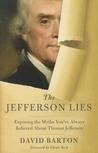
 The Jefferson Lies: Exposing the Myths You've Always Believed about Thomas Jefferson by David Barton
My rating: 4 of 5 stars
I think this book was worth the read and I highly recommend it. Aside from all of the things I learned about Thomas Jefferson, I gained a lot of important insights into the way our society currently views history, people, politics, religion, civil rights, and so on. It has given me some useful tools for recognizing truth and lies when I see things on the internet.
Many of the myths that are addressed by Barton originated with people of Jefferson's time who were trying to ruin him politically. The rumor that he fathered at least one of the children of one of his slaves probably originated with a person who got mad at Jefferson and spent the rest of his life running a smear campaign against him (Jefferson actually wanted to free his slaves but was prevented by Virginia laws). Many of the myths about his religious beliefs were originated by clergymen and/or politicians who were Federalists and told outright lies about Jefferson in order to dissuade people from voting for him. It's kind of like what would happen if someone 80 years from now used nothing but Fox News to write a biography of Barack Obama. Probably the biography would be biased and not very accurate. Barton has done a great job looking at the original sources, especially Jefferson's own writings, and trying to understand the historical context so he could paint a more accurate picture of what really happened.
I do think that it might have been better to organize the book a little differently. Most of the chapters were about Jefferson's religious beliefs, and by the end I felt like it was becoming a little overkill because the myths were already obviously false based on previous chapters. That's not to say that he shouldn't have included some of the content, but I think it should have been organized a little better so that it didn't feel like I was reading the same chapter over and over again.
The last chapter is really interesting, and not just because of the content, but also because Barton's point of view about Christianity is very obvious. In the last chapter he is addressing whether Jefferson was an atheist and whether he was a Christian. After addressing whether he was an atheist (definitely not), he moves on to discuss why he believes Thomas Jefferson probably was not a Christian when he died. In his later years, Jefferson was very interested in the Restorationist movement that aimed to become more like the church Christ organized on the earth. The leaders of this movement generally rejected the creeds and the doctrine of the Trinity because these were not in the Bible. Jefferson seemed to agree with them and wrote that he believed that the focus should be mostly on the gospels and not on the epistles. That is why Barton argues that Jefferson was not a Christian. (LDS friends, keep in mind that most Christians' definition of being a Christian is not simply believing in Christ, but also has a great deal to do with whether a person believes in the creeds and the Trinity.) Interestingly, Sidney Rigdon was a follower of Alexander Campbell, one of the leading ministers in the Restorationist movement. A lot of the principles supported by the Restorationists were also important in the organization of the LDS church, which is interesting since Thomas Jefferson was one of the Eminent Men whose temple work was done by proxy by Wilford Woodruff.
View all my reviews


No comments:
Post a Comment